



How to sign your work. Inspired by Matisse, Michelangelo, and other greats (part 1).
How should you sign your artwork? And where?
Michelangelo signed his Pieta while it was already on exhibit. He sneaked in at night and chiseled his name into a sash he put across Mary's torso.
He chiseled "Michelangelo Buonarroti, Florentine, I made this."

It is carved into a grieving Mary as the dying Christ is lying across her lap.

It is the only piece he ever signed. It is said he had some misgivings after he carved his name into this piece. But as demonstrated by a master, you can be as bold as the spirit moves you in your artistic signature.
Or, at the other end of the spectrum, you can follow the example of Bansky, a famous yet anonymous street artist who has not yet affirmed his name or his identity as an artist. He has created satirical, political, or charming murals and portraits on the side of buildings and public spaces.

Girl with Balloon attributed to Bansky. Waterloo Bridge, South Bank, London, 2002.
By Banksy - https://www.banksy.co.uk/out.html (cropped), Fair use.
His art first appeared as graffiti and since it was illegal to paint graffiti, he did not declare himself as the creator of the work.
What to include in your signature? (Or is it an autograph?)
When we think of celebrities, we consider their “signature” their autograph because it is a personal representation of how they are conveying their name—or what they are known as—to the public.
In reference to artists, I am using the term signature as a synonym for autograph. It may or may not be the artist’s legal name, or as you can see below, they may even use a symbol rather than a name.
Typically for signatures, artists use only their name. Use your first name or last name or both. With initials or not. It doesn’t have to be your legal signature. For example, Winslow Homer sometimes used a signature incorporating an oil palette drawing around his name.

Here is an example of how he signs a letter. it looks completely different. "Yours very truly, Winslow Homer."

Image from the Schulson Auction House.
Although he sometimes signed in a much simpler hand with his name almost printed and the date, Oct 16th 1878.
 Image from RR Auction House.
Can I ever change my artist’s signature?
Many artists morph their signatures throughout their careers. In what today we would consider a marketing effort, Artemisia Gentileschi changed her signature depending on which town she was in at the time the painting was completed. A Florentine signature worked best in Florence. A Roman one in Rome. (See Artemisia's signatures in part 2 of this blog post.)
James McNeill Whistler used 12 variation of his signature. Renoir used eight. And, as we will see, Matisse also used many signatures. I don’t think I have found all of Matisse’s, but I’ll keep looking.
Examples of Signatures by Famous Artists
Italian painter, Caravaggio (1510-1671)

"Michelangelo Merisi da Caravaggio" is known as "Caravaggio." But Caravaggio was actually the name of the town he grew up in.
This was true for Leonardo da Vinci, also. He was named for the town he grew up in, Vinci. Here is the signature of da Vinci.

Below is the signature of the artist we know as Michelangelo.

Moving from the 16th and 17th C, into the 19th C, here is the signature of Vincent Van Gogh.

Vincent Van Gogh, Dutch painter
Pierre-Auguste Renoir (1841-1919) was part of the vibrant end-of-the-century group of artists in Paris who bridged the years from the 19th to the 20th C.

He was a French artist who was known for capturing the life and personality of Paris in a very coloroful, creative time.
Toulouse-Lautrec was part of that network, but always a bit of an outsider. A French artist of the post-Impressionist era, he was best known for his posters for circuses and theater performances. He used variations on a theme for his signature.

Toulouse Lautrec sometimes used his initials incorporated in a logotype, sometimes he used his name, and as in the above poster, he used a combination of the two. This is his signature on the poster for the Moulin Rouge, a dance hall in Paris. See my blog post discussing the Japanese influence on artists and social life at this time.
He also sometimes used his monogram, "H-T-L" inside a circle for his signature.

John Singer Sargent (1856-1925) was a master of using the inherent strengths of watercolor to tell the story of light and color in his paintings. See my blog post "Laundry in the Hands of John Singer Sargent" to learn how he does it.

John Singer Sargent, American watercolorist, portraiture artist, and oil painter.

Georgia O'Keeffe, American artist
American abstract expressionist painter, who oftenn painted in watercolor, in addition to other sometimes experiemental media, Helen Frankenthaler had a bold cursive signature. One of my favorite quotes of hers is:
"There are no rules. That is how art is born, how breakthroughs happen. Go against the rules or ignore the rules. That is what invention is about."

Helen Frankenthaler
For someone who uses such precise strokes in his paintings, N. C. Wyeth's signature is a mess. I don't know why.

N.C. Wyeth, American watercolorist.
Gustav Klimt is the artist who created the lusty, impassioned painting "The Kiss" among others.


Gustav Klimt, Austrian painter (1862-1919)
You may not be familiar with the name Jessie Wilcox Smith (1863-1935), an illustrator who created charming scenes often featuring children and families.


Notice that on this illustration she has also lettered her name in the lower left hand corner.
Some artists use onnly their initials.

JMW Turner, English artist.
For more on JMW Turner, read "Did JMW Turner Really Use Bread in his Watercolor Paintings?"
Some artists used symbols or drawings incorporated into their professional signature.

Johannes Vermeer, Dutch painter

Wassily Kandinsky, Russian painter

Albrecht Durer, German artist
James McNeill Whistler used a form of a butterfly for his signature. We can watch the evolution of his initials into a butterfly.

From Whistler House Museum of Art,
Lowell Art Association, Lowell, MA.
Whistler is famous for his painting known as "Whistler's Mother." For more on him, read my blog post.
Matisse (1869-1954)
He's an example of someone using various styles and various media, from pencil to paint to ink, for his signature. These are the ones I found.


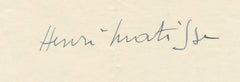


Henri Matisse signature on paper,
Nice, France, October 29, 1931.

Matisse signed this painting of his wife, Madame Matisse, in the upper left corner. His other signatures are placed at the bottom right of left. This painting, "Woman in Hat," is in the collection of the Ssn Francisco Museum of Modern Art. To read more about Matisse, read my blog post.
Should I use a pen to sign my art?
It is often recommended that you sign your art in the medium you used to create the art: if oil, then oil; if acrylic, then acrylic; if marble, then chisel it into the marble.
I don't advocate signing in a permanent marker. A permanent marker can seem obtrusive on a piece of art. And, more importantly, a “permanent” marker tends to bleed or fade. I once had a pair of hockey gloves from Wayne Gretzky that I purchased at a celebrity auction. They were signed in some sort of "permanent marker," and sadly, the signature disappeared in a few years. It is not convincing to say, "Well, there used to be a signature here by Wayne Gretzky!"
I typically sign my two-dimensional art with an ordinary #2 pencil. The graphite, (which is the “lead” in pencils), can last hundreds of years. Plus, you can write with the gusto, or a tiny script; lightly or boldly.
For my textile art, I create a label that I stitch into the back of the piece, and sometimes I incorporate my initials into the front of the piece.
Where should I sign?
Most artists sign in the lower right or lower left corner. But it is personal preference. You can sign within the art, or on the mat, or even on the frame if you want. Of course, the frame can get separated from the art, as can the mat, but again, it's up to you.
As shown with Matisse, Toulouse-Lautrec, and Wilcox Smith, some artists tuck their signatures in on the surface of the painting itself.
Should I date my work or include the name of the artwork in my signature?
Generally, on the back of the watercolor painting I add the date and the name of the painting. Including the name of the art on the back allows me to make sure the name travels with the painting. And although people rarely use the name when they talk about a piece, it helps you accurately keep track of your inventory if each piece has a meaningful name.
Does the signature add value? Does an unsigned piece of artwork have less value?
Not necessarily. But for me, adding my signature authenticates the piece. It helps me decide that my piece has met my expectations and I am happy to send it out in the world. My artist signature is on all my paintings. It's at the top of my website, and I use it for my branding.
When I add my signature, I am “owning” the creative process that nurtured and nudged the piece into fruition. It’s a satisfying feeling of completion. Find a signature that empowers you.
When should you start adding your signature or your autograph to your work?
Start as soon in your artistic journey as you want. It's fulfilling. It's something you have created. Signing feels like an exclamation of: "I made this!" It’s what Michelangelo wrote when he signed his first Pieta.
And here is my signature:

The Getty Museum Blog has a bibliography for research on art signatures. If you are interested in an academic study of signatures, or want to authenticate a piece of art, check with a reputable art dealer, curator, historian, or other expert.
Part 2 of this blog series on signatures focuses on Artemisia Gentileschi and other artists.
Watercolor can provide a vast array of styles and improvisations. If you are interested in taking watercolor lessons from me, please contact me through my link on my Learn page. Or, if you have questions about lessons, use the contact page.
Did you like this information? All of my blog posts start as an e-letter and my next e-letter is due out soon. Don't miss out!


Send a message or leave a comment